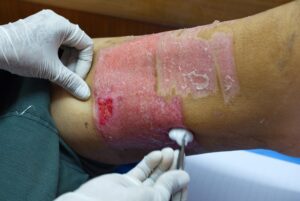
Severe fire pit burns can require far more than emergency treatment and dressings. When thermal injury destroys skin too deeply to heal adequately on its own, treatment may involve surgical removal of damaged tissue, skin grafting, repeated operations, specialized wound care and prolonged rehabilitation.
Skin graft surgery places healthy skin over a prepared burn wound. When a patient’s own skin is used, the procedure also creates a donor site that must heal. Someone with extensive burns may therefore be recovering simultaneously from the original burn wounds, grafted areas and donor sites.
The medical course can continue long after the initial hospitalization. Operative reports, burn photographs, graft and donor-site records, rehabilitation notes and recommendations for future surgery can help establish what the injury required and how it may affect the person’s health, function and quality of life.
Burn depth is only part of the picture. Doctors may also evaluate the percentage of total body surface area involved, the location of the injury, whether critical areas such as the hands or face are affected, and whether the wounds can close without surgery. A smaller but very deep burn in a functionally important location can create substantial treatment needs even when the overall burned area is limited. Medical teams may evaluate fire pit burns for:
The decision to graft is individualized. Medical records can show why surgery was recommended, which areas required treatment and whether additional procedures were anticipated.
Deep burns can leave tissue that is no longer viable. Debridement refers broadly to removing dead tissue, contaminants or other material from a wound. Surgical excision can involve removing burned tissue to create an appropriate wound bed for closure or grafting. These can be significant procedures rather than simple wound cleaning. The amount of tissue removed, location of the burn, anesthesia requirements, the patient’s overall condition and the timing of later grafting can all vary with the injury.
For a family reviewing a serious burn case, operative records can answer important questions. How deeply was the tissue damaged? Which body areas required excision? How much tissue had to be removed? Was grafting performed during the same operation or later? Were additional operations anticipated?
A skin graft covers an injured area with skin placed over the prepared wound. In an autograft, surgeons harvest healthy skin from another area of the patient’s body and transfer it to the burn site. The location from which that skin is taken is called the donor site. Skin grafting can be particularly important when a burn is too deep to close adequately through normal healing. The American Burn Association guidance on burn wounds and skin grafts describes burn-wound treatment and different grafting approaches used to cover deep injuries.
Grafting provides wound coverage, but it does not make the injury disappear. The patient must still heal at the grafted burn site and at the donor site, and both areas may require substantial wound care. A serious fire pit burn can therefore create a treatment sequence such as:
deep burn → excision/debridement → wound preparation → skin graft → donor-site healing → rehabilitation → scar management → possible reconstruction
That sequence is important when evaluating the full consequences of a catastrophic burn rather than focusing only on the initial emergency treatment.
Not every skin graft is the same. Surgeons can use different grafting techniques depending on the size and location of the wound, available donor skin and functional or reconstructive goals. Common approaches can include:
The type of graft documented in an operative report can help explain the size and location of the wound, the amount of donor skin available and the medical objectives of treatment.
An autograft transfers skin; it does not create new skin. When surgeons harvest healthy skin from another area of the patient’s body, the donor site becomes another wound requiring treatment. For someone already coping with serious burns, a donor site can add another source of pain, sensitivity and wound care. Dressings may be required at both the grafted burn and donor areas, and mobility can be affected depending on where skin was harvested. Recovery can involve:
The donor-site experience is therefore part of the overall burden of treatment and should not disappear from the medical history merely because the skin was harvested from an otherwise unburned part of the body.
Skin grafting is an important treatment for deep burns, but recovery is not always a straight path from surgery to healing. A graft must adhere to the prepared wound and develop an adequate blood supply. The wound environment, extent of injury and the patient’s medical condition can affect healing.
When complications occur, treatment can become longer and more demanding. Depending on the individual case, medical records may document:
These complications can materially change the consequences of a fire pit burn. The complete treatment history—not simply the fact that “a skin graft” occurred—can be important when evaluating medical expenses, pain, impairment and future care.
Serious burn treatment is not always completed during a single surgery. A patient may undergo staged excision and grafting, additional wound coverage, treatment of complications or later reconstructive procedures. The number of operations can depend on the extent and location of the burns, the amount of donor skin available, healing of previous grafts and whether scarring later interferes with appearance or function.
A complete treatment history may therefore include the initial burn hospitalization, multiple operations, graft and donor-site care, rehabilitation, scar management and future procedures. Describing the injury simply as “a burn that required a skin graft” can substantially understate what the patient actually experienced.
Severe fire pit burns requiring skin grafts can involve repeated operations, painful donor-site wounds, permanent scarring and years of rehabilitation. Experienced fire pit burn injury lawyers can investigate whether defective products, alcohol fuel containers or inadequate warnings contributed to the accident while documenting surgical expenses, future medical care, lost earnings and lasting physical impairment.
The accident mechanism can help explain the location and severity of the burns. Alcohol-fueled fire pits can expose people to sudden flame, burning liquid fuel and secondary fires rather than only brief contact with a stationary flame.
During flame jetting from a fire pit, flame and potentially burning liquid fuel can be expelled outward from a fuel container, exposing the person refueling and nearby bystanders. Burning liquid can reach skin or clothing and extend the duration of thermal exposure.
With ethanol flashback ignition, flame propagates backward toward the fuel source during refueling. The person holding the fuel container may have the hands, arms, face and upper body close to that pathway. If the event progresses into container ignition, flame jetting or a pool fire, the resulting burns can become more extensive. Identifying the mechanism matters because medical records establish what happened to the body, while the fire pit, fuel container, warnings, photographs, video and physical evidence can help explain why those injuries occurred.
The location of a deep burn can be as important as its size. Burns involving the face and hands can create significant functional and reconstructive problems because these areas perform complex movements and are highly visible. Serious fire pit facial burns and disfigurement can require grafting, scar treatment and later reconstruction. Burns involving the eyelids, lips, nose, ears or neck may affect function as well as appearance, while facial scarring can remain visible long after the wounds have closed.
Hand burns present different problems. Scar formation and contraction can affect fingers, grip, dexterity and range of motion. Treatment may therefore continue after wound closure through therapy, splinting, scar management and, in some cases, later reconstructive procedures.
The treatment goal is not simply to close the wound. Burn specialists may also work to preserve movement and function, limit the effects of contracting scar tissue and address permanent changes in appearance as healing progresses.
A successful graft does not necessarily end burn treatment. Newly grafted skin can remain fragile and sensitive, while scar tissue can mature and change over many months. Recovery from a major burn can extend well beyond wound closure. Mayo Clinic guidance on major burn treatment recognizes that serious burns may require skin grafts, specialized burn-center care, physical therapy and months of follow-up treatment aimed at healing, reducing scarring and restoring function.
Long-term burn care may involve:
For families, recovery should not be measured simply by whether the patient has left the hospital. Medical consequences may continue through rehabilitation, scar maturation and future reconstructive treatment.
A severe burn claim should account for treatment that has already occurred and medically supported care that may reasonably be required in the future. A patient who has completed the initial grafting process may still face scar management, therapy, reconstructive procedures or treatment for functional limitations. Future-care issues can include additional surgery, scar-release procedures, continued physical or occupational therapy, treatment of painful or sensitive scars, management of contractures and reconstructive treatment intended to improve function or appearance.
The need for future care should be based on the patient’s actual medical condition and qualified medical recommendations rather than assumptions. Medical records, physician opinions, rehabilitation evaluations and documented treatment plans can help establish what future care may be necessary and why.
A serious burn case should preserve more than the final diagnosis and hospital bill. The treatment record can show how the injury evolved, why surgery was necessary and what consequences remained after the wounds closed.
Important medical evidence can include:
Photographs can be particularly important because written records may not fully communicate the appearance of extensive burns, grafted tissue, donor sites and the progression of healing. The medical evidence should also be evaluated together with accident evidence. Product photographs, video, fuel containers, warnings, instructions and purchase information may help reconstruct how the fire occurred and identify the companies associated with the products.
Why did the doctors need to use a skin graft?
Deep burns can destroy skin too extensively to heal adequately on their own. After damaged tissue is removed and the wound is prepared, grafting can provide skin coverage. Whether a graft is necessary depends on the individual injury and treatment plan.
Where does the grafted skin come from?
An autograft uses healthy skin harvested from another part of the patient’s own body. That location becomes the donor site and must heal separately from the original burn.
Can someone need several burn surgeries?
Yes. Severe burns can require staged treatment. A patient may undergo excision and grafting during the acute phase and later procedures for wound coverage, scar release, reconstruction or functional problems.
Does a skin graft eliminate permanent scarring?
No. Skin grafting treats and closes a deep wound, but permanent scarring can remain at both the burn and donor sites. Scar appearance, tightness, sensitivity and function may also change over time.
Can additional surgery be needed years later?
It can be. Some patients later undergo reconstructive or scar-release procedures when mature scarring affects movement, function or appearance. The need for future treatment depends on the individual injury and recovery.
Why is therapy necessary after burn surgery?
Healing skin and scar tissue can tighten and restrict movement. Physical and occupational therapy can help preserve strength, mobility and function, particularly when burns involve the hands, joints or other functionally important areas.
The need for grafting or repeated surgery demonstrates the seriousness of the injury, but it does not by itself establish who was legally responsible. Liability depends on the particular fire pit, fuel, fuel container, warnings, accident mechanism, distribution chain and applicable law.
Depending on the evidence, an investigation may involve the fire-pot manufacturer, fuel or container manufacturer, importer, distributor, retailer, online seller or component supplier. Potential legal issues can include defective design, inadequate warnings or instructions, manufacturing defects, negligence, breach of warranty and other claims recognized by the governing jurisdiction.
Where the product was purchased can also matter. Fire pits and alcohol-fuel products may be sold through traditional stores, Amazon, eBay and other online marketplaces, while used products may be offered through resale platforms. Determining retailer and online seller liability can require identifying the actual seller, manufacturer, product listing, warnings supplied with the product, distribution chain and any recall or safety information associated with the particular fire pit or fuel.
The investigation should begin with evidence rather than an assumption that either the consumer or a particular company was automatically responsible.
both the accident and the medical course. Operative reports, burn photographs, graft and donor-site records, rehabilitation notes, future surgical recommendations and evidence concerning the fire pit and fuel system can all become important.
David P. Willis has represented seriously injured people and families in catastrophic injury and defective-product litigation for more than 40 years. Severe fire-pot burn cases can involve product engineering, warnings, fuel systems, accident reconstruction, extensive medical treatment and permanent injury.
Texas Board of Legal Specialization. He was licensed in Texas in 1983 and New York in 2005 and formerly served as a Briefing Attorney to Justice Robert M. Campbell of the Supreme Court of Texas. Cases outside those jurisdictions can be handled with qualified affiliated or local counsel when required without increasing the client’s attorney fee.
Cases are handled on a contingency-fee basis. Attorney fees are not owed unless compensation is recovered.
Families facing skin grafts, repeated surgery or long-term treatment after a fire pit burn can discuss a severe fire pit burn case with our legal team for a free, confidential case evaluation.
Copyright © 2026 All Rights Reserved.
FirePitLawsuits.com – National investigations of alcohol-fueled fire pit explosions and burn injuries. Willis Law Firm handles product defect cases nationwide. David Willis is licensed by the State Bar of Texas since 1983 and Board Certified in Personal Injury Trial Law by the Texas Board of Legal Specialization since 1988 — a certification held by fewer than 2% of Texas attorneys. He is admitted to practice law in New York and was recognized by the American Association for Justice with the Steven Sharp Public Service Award for product defect investigation work that contributed to one of the largest federal safety recalls in US history. Willis Law Firm, 5005 Riverway Drive, Suite 160, Houston, Tx. – Principal Place of Business – All Meetings by Appointment Only.