Fire Pit Burns & Explosions

Board-Certified Personal Injury Trial Lawyer

$100,000,000's Recovered for Clients

Fire Pit Burns & Explosions

$100,000,000's
Recovered for Clients

Tabletop Fire Pit Lawsuits & Serious Burn Injury Claims

Tabletop fire pits are small decorative products, but accidents involving alcohol or other liquid fuels can cause catastrophic burns. A sudden fire can expose the person handling the device as well as family members, children and other bystanders gathered nearby. CPSC has identified both uncontrolled pool fires and flame jetting as hazards associated with certain liquid-burning tabletop products. U.S. Consumer Product Safety Commission

Children playing in fire in tabletop fire pitA lawsuit may require examination of more than the decorative burner. The fuel, bottle, extinguishing system, warnings, packaging, manufacturer, importer and seller can all become important. The central legal questions are what happened, which products were involved, whether a defect or inadequate warning contributed to the accident, and which companies may be responsible under applicable law.

Families do not need to know the technical cause before seeking legal advice. Preserving the fire pot, fuel container, original box, instructions, photographs and purchase records can allow the accident to be reconstructed before important evidence disappears.

Several Fire Mechanisms Can Produce a Sudden Fireball

Witnesses may describe an accident as an explosion even when the fire pot itself did not rupture. Liquid-fueled products can produce several different fire sequences, and identifying the mechanism can affect the product-liability investigation.

A serious event may involve:

The broader question of why a tabletop fire pit suddenly exploded should therefore be answered from the physical evidence, witness accounts and available video rather than from the word “explosion” alone. CPSC describes flame jetting and uncontrolled pool fires as separate hazards. Its warnings explain that a small flame can be difficult to see during refueling and that pooled or spilled alcohol can produce spreading flames outside the intended burn area. U.S. Consumer Product Safety Commission

Refueling Accidents Can Involve a Flame That Appeared Extinguished

A consumer may approach a fire pot believing combustion has stopped and bring fresh liquid fuel close to the burner. Alcohol flames can be difficult to see under some conditions, especially when the flame is small, while alcohol vapor itself is invisible. The relationship between difficult-to-see alcohol flames and refueling can become important when determining what the user could perceive, how the device was intended to be extinguished and whether the instructions adequately addressed cooling and refilling.

Health Canada similarly recognizes that low flame visibility can lead a person to believe a portable fire pot is extinguished and describes flame jetting as a foreseeable hazard when pourable alcohol fuel is added under certain conditions.  The fact that a person poured fuel does not automatically establish fault. Product design, warnings, extinguishment procedures, the fuel container and the actual sequence must be evaluated under the governing law.

Flashback and Flame Jetting Require Different Analysis

During refueling, ignition of vapor associated with a pouring stream can allow flame to propagate toward the fuel source. That backward movement is generally described as flashback.

fire pit fire flashback and jettingA later fuel-container event can produce flame jetting, in which flame and potentially burning liquid are projected outward. Detailed fire pit flame-jetting injuries may involve the person holding the bottle as well as people positioned away from the burner.

The fuel bottle does not necessarily have to rupture for a violent fireball to occur. Health Canada describes flame traveling toward a fuel container and the resulting potential for rapid projection of burning fuel toward users and bystanders. Preserving the bottle, opening, cap and internal components can help distinguish among these mechanisms.

Pool Fires Can Spread Burning Fuel Beyond the Burner

An uncontrolled pool fire presents a different hazard. Pooled or spilled liquid fuel can burn across a surface and produce larger, hotter flames beyond the intended combustion area.

CPSC has repeatedly identified uncontrolled pool fires alongside flame jetting in its actions involving liquid-burning tabletop products. Recent warnings concerning Rozato, Northlight and Houswise products identify both hazards. The investigation may consider the reservoir, fuel capacity, containment, stability and whether liquid escaped onto a table, patio, floor, clothing or surrounding materials. That distinction matters because a family may accurately remember a sudden fireball even when the physical evidence ultimately shows spilled fuel or a pool fire rather than container rupture.

Safety Standards and Government Actions Can Provide Technical Evidence

ASTM F3363 addresses certain freestanding liquid- and gel-fueled portable devices. CPSC specifically cited ASTM F3363-19 in its December 2024 warning concerning certain pooled-alcohol and other liquid-burning fire pits. CPSC stated that the standard is designed to address pool-fire and flame-jetting hazards.

Detailed ASTM fire-pot safety requirements can provide technical context concerning matters such as fuel containment, stability, extinguishment and warnings. The edition relevant to a particular product should be determined from the product’s history rather than assumed.

Current CPSC tabletop fire pit recalls and warnings can also identify brands, models, reported incidents, remedies and recognized hazards. CPSC actions have included Colsen, FLIKRFIRE, Five Below, Rozato, Northlight, Houswise and Brookstone-branded products.  A government action does not automatically establish civil liability, and the absence of a recall does not establish that a product was safe.

More Than One Company May Need to Be Identified

The company whose name appears on a fire pot may not be the factory that made it. Some products are imported, privately labeled, distributed through several companies or sold under different brand names.

Depending on the transaction, an investigation may involve:

Original packaging can be particularly useful because model, UPC, importer or company information may appear on the box even when little identifying information appears permanently on the device. The existence of multiple companies does not establish liability against all of them. Each entity’s role must be determined from the evidence and applicable law.

Online and Used Sales Can Complicate Warnings and Product Identification

Fire pots may be purchased through traditional retailers, Amazon, eBay or other e-commerce channels and later resold through Craigslist, Facebook Marketplace or similar secondary markets.

Determining online seller and retailer liability can require identifying the actual seller, importer, private-label company and transaction structure. A used product may reach a later purchaser without its original box, manual or warning inserts. This can create an important factual distinction between a warning that existed somewhere in the original materials and a warning that actually accompanied the product received by the consumer.

Order histories, listing screenshots, seller identities, shipping records and communications should be preserved because digital information can change or disappear.

The Fire Pot and Fuel Bottle May Come From Different Companies

A refueling event can involve two separate consumer products. The fire pot may have one manufacturer and seller while the alcohol fuel and bottle come from another.
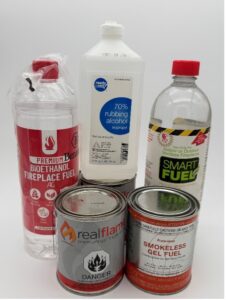
fire pit rubbing alcohol, bioethanol and gel fuelExhibit 34: Exemplar Fire Pit Alcohol and Ethanol Fuel Containers

Detailed fire pit fuel and container liability can involve the formulation, bottle opening, dispensing system, warnings and any flame arrestor or other flame-mitigation device. Health Canada has specifically addressed the combined use of portable fire pots and pourable alcohol-fuel containers lacking certain functional flame-mitigation protection. Canada

The original fuel bottle should be preserved even if it appears empty or undamaged. Focusing exclusively on the decorative burner can overlook another product involved in the event.
Physical and Digital Evidence Should Be Preserved Early

Important evidence can disappear during cleanup, product returns or ordinary account changes. A recalled product may also be destroyed before anyone considers its potential evidentiary value after an injury.

Preserve, when available:

Proper preservation of tabletop fire pit evidence can help establish the exact product, its post-accident condition and the transaction through which it reached the consumer. Do not conduct a home reenactment or refill and ignite the product to see whether the event happens again.

Severe Burns Can Produce Lasting Medical and Financial Losses

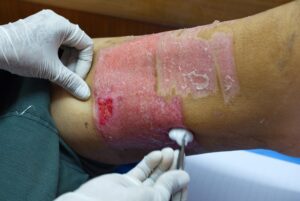
severe fire pit 3rd degree burns need donor graft sitesThe physical size of a decorative burner does not predict the severity of an accident. CPSC has documented serious and fatal injuries involving tabletop products, including third-degree burns. Its Colsen recall reported 19 burn injuries, including two incidents involving third-degree burns over more than 40% of the victims’ bodies. U.S. Consumer Product Safety Commission

Severe and third-degree fire pit burns may require burn-center hospitalization, debridement, grafting, rehabilitation and later reconstruction. Permanent scars, contractures and loss of function can continue long after the original wounds close.

Depending on applicable law and evidence, damages may include medical expenses, future care, lost earnings or earning capacity, physical pain, impairment, permanent disfigurement and other recoverable losses. There is no universal dollar value for a claim. Liability evidence, injury severity, long-term consequences, economic losses, available sources of recovery and governing law all matter.

A tabletop fire pit may be small, but the resulting burns can require multiple surgeries, grafting and long-term rehabilitation. Tabletop fire pit injury lawyers can evaluate the product and fuel evidence, identify potentially responsible companies and document the medical and financial consequences when a defective product or inadequate warning may have contributed to the accident.

Questions Families Ask After a Tabletop Fire Pit Burn

Does the fire pit have to physically explode?

No. Serious injuries can result from flashback, flame jetting, pooled or spilled burning fuel and other fire mechanisms without the fire pot itself rupturing.

What if nobody saw a flame before fuel was added?

A small alcohol flame can be difficult to perceive under some conditions. The evidence should establish the actual circumstances rather than assuming the absence of an obvious flame meant combustion had stopped.

Does refueling automatically make the person pouring fuel responsible?

No. Refueling can be highly relevant, but responsibility depends on the design, warnings, instructions, products, conduct of the parties and applicable law.

What if another person poured the fuel and I was burned?

Bystanders can suffer severe injuries from projected or spreading burning fuel. A potential claim depends on the accident circumstances and governing law.

What if a different brand of fuel was used?

Fuel compatibility and instructions can matter, but use of another brand does not automatically resolve liability.

Does the product have to be recalled?

No. A recall can provide important evidence, but the absence of one does not prevent investigation of design, manufacturing, warnings or other issues.

What if it was bought through Amazon or used through Craigslist?

Preserve the listing, seller identity, order or payment records, messages and shipping information. Those records may help trace the distribution chain.

What if the original box is gone?

Product labels, photographs, instructions, online records, credit-card history and seller information may still help identify the fire pot.

How long does a family have to investigate a claim?

Legal deadlines vary by jurisdiction and claim. Evidence can disappear well before a filing deadline expires, so the applicable deadline should be determined from the specific facts.

Talk to a Board Certified Trial Lawyer About Fire Pit Burn Claim

David P. Willis — Board Certified Personal Injury Trial Lawyer for Tabletop Fire Pit Burn LawsuitsDavid P. Willis has been Board Certified in Personal Injury Trial Law since 1988 by the Texas Board of Legal Specialization. He has represented seriously injured people and families in catastrophic injury and defective-product litigation for more than 40 years and is licensed in Texas and New York. He formerly served as a Briefing Attorney to Justice Robert M. Campbell of the Supreme Court of Texas.

Cases outside Texas and New York can be handled with qualified affiliated or local counsel when required without increasing the client’s attorney fee. Families investigating catastrophic burns involving a tabletop fire pit can evaluate a tabletop fire pit lawsuit with our legal team in a free, confidential consultation.

Evidence Can Disappear Long Before a Lawsuit Is Filed

The fire pot, fuel bottle, packaging, instructions and purchase records should be preserved after a serious burn. Online listings can be changed or deleted, surveillance video can be overwritten, sellers can disappear and witnesses’ memories can fade. The products should not be tested, altered, returned or destroyed while evidence-preservation issues are being addressed.

Legal deadlines vary by jurisdiction, but important evidence can disappear well before those deadlines expire. Early preservation can help determine what happened and identify the companies involved.

Call Us 24/7 at 1-800-447-FIRE

Submit the form below for a Free & Confidential Case Review

Legal Help

GET IN TOUCH

CALL 24/7

GET A FREE CASE REVIEW